Webb Finds Host of Most Distant Fast Radio Burst
Omega Science News Desk · Friday, October 9, 2026 · Hosted by Don Sol
OPENING SIGNAL
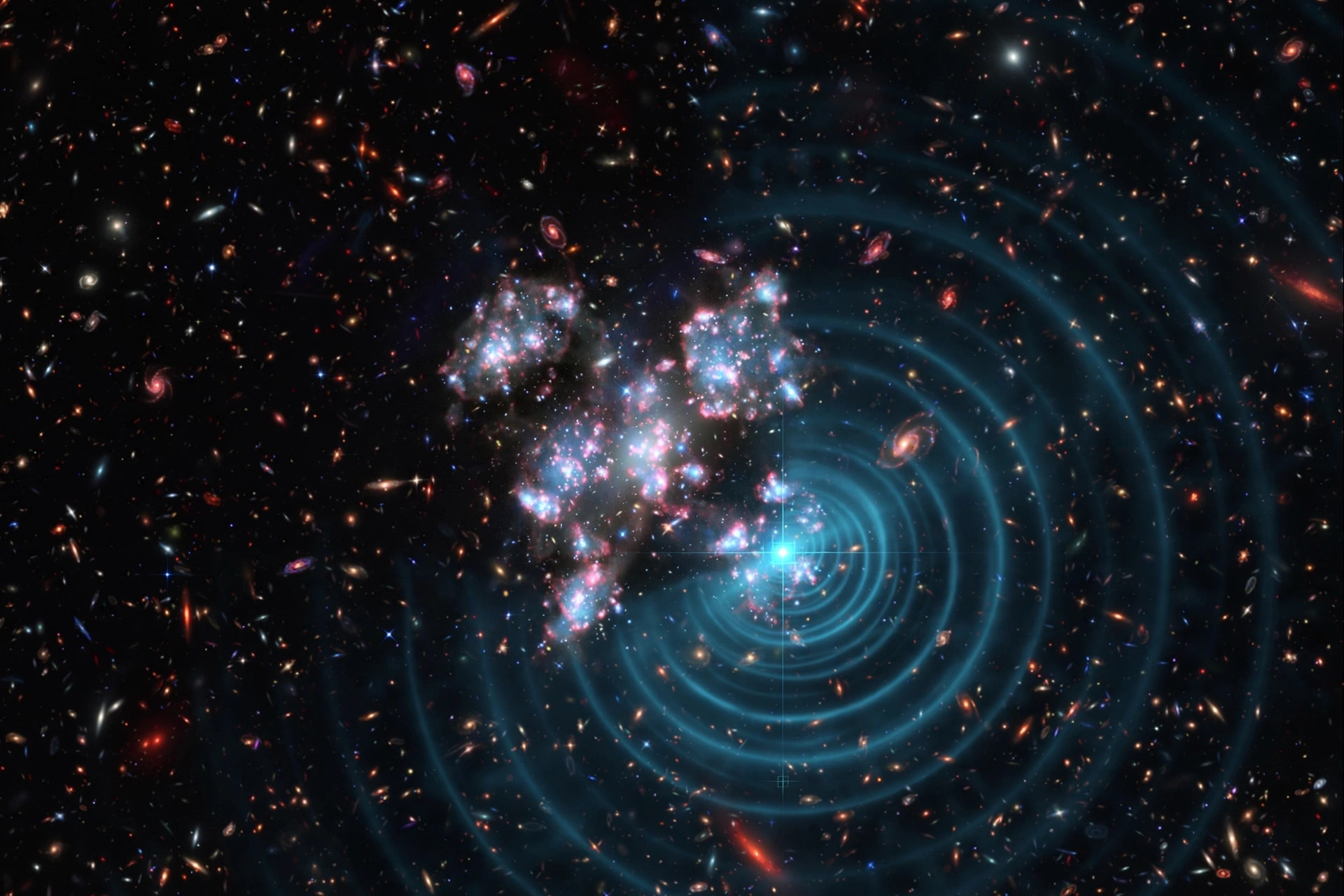
[T] Astronomers using MeerKAT and the James Webb Space Telescope localized FRB 20240304B to a low-mass, clumpy, star-forming dwarf galaxy at redshift 2.148 ± 0.001. That places the burst roughly 3 billion years after the Big Bang, during cosmic noon. The host is about 1,000 times less massive than typical FRB hosts. This favors a young magnetar origin over a delayed neutron-star merger for this event. (Science, 8 Oct 2026; NASA release)
1. THE BIG DISCOVERIES
[T] Webb + MeerKAT pin most distant FRB host to tiny star-forming dwarf.
WHAT HAPPENED: MeerKAT detected FRB 20240304B on 4 March 2024. Webb NIRCam found the host; NIRSpec measured z = 2.148. Host stellar mass ~10^7 M⊙, high specific star-formation rate, low metallicity. Sightline also intersects Virgo Cluster and a foreground group.
WHY IT MATTERS: Doubles the redshift reach of localized FRBs and samples ionized baryons across ~80% of cosmic history. Young, low-mass host makes merger origin unlikely (merger delay typically billions of years).
WHAT IT COULD BECOME: [I] More distant FRBs with MeerKAT + Webb will map magnetar formation during peak star formation and refine cosmic-web probes.
WHAT IT MEANS FOR YOU: A millisecond radio flash from when the universe was young just told us where some of these events form.
[T] JWST time-series spectra show evidence of patchy water clouds on coldest known brown dwarf.
WHAT HAPPENED: 11-hour NIRSpec time series (15-min cadence, R~1000, 2.87–5.27 μm) of WISE 0855 (T≈265 K, 7.4 ly). CO absorption varies up to 10% peak-to-peak and correlates with PH3. Models including patchy water clouds fit better than clear models. (arXiv:2609.20664, accepted AJ; Miles et al.)
WHY IT MATTERS: First time-resolved medium-resolution view that separates cloud thickness changes from deeper quenched chemistry on an ultracool object.
WHAT IT COULD BECOME: [I] Template for weather on cold gas giants and Y-dwarfs.
WHAT IT MEANS FOR YOU: Clouds change thickness on a nearby world colder than Earth's surface.
[T] Layered Co₁/₄TaSe₂ shows altermagnetic spin-splitting.
WHAT HAPPENED: ARPES and spin-resolved ARPES reveal g-wave spin splitting of Fermi surface that vanishes above Néel temperature ~178 K. Zero net magnetization, opposite spins on split bands. (Nature Communications, Sprague et al.)
WHY IT MATTERS: Confirms altermagnetism in a van-der-Waals layered material that can be stacked with other 2D systems.
WHAT IT COULD BECOME: [H] Platform for spintronics without stray fields.
WHAT IT MEANS FOR YOU: A new magnetic order that carries spin information without acting like a fridge magnet.
[T] Bethe strings observed in ultracold cesium gas (1931 prediction). Expansion: paper 29 Aug, coverage 9 Oct.
WHAT HAPPENED: Cs atoms cooled to nK, loaded into ~thousands of 1D tubes. Interaction sweep from repulsive to attractive creates multiparticle bound states (Bethe strings, >6 particles). Binding energy measured; states survive 1D collisions but disintegrate in 3D. (Nature Communications, Horvath et al.)
WHY IT MATTERS: Controllable realization of pure interaction-bound multiparticle states predicted by Bethe.
WHAT IT COULD BECOME: [I] Laboratory for 1D quantum many-body physics beyond numerics.
WHAT IT MEANS FOR YOU: Atoms bind without chemical bonds, only because they are confined to one dimension.
[T] Phage protease cuts bacterial sensor and triggers CBASS suicide defense.
WHAT HAPPENED: In CBASS system, certain phage proteases cleave a host sensor protein, activating the pathway that causes the infected cell to self-destruct before the virus spreads. Published in Science (Hobbs & Kranzusch). University of Utah Health release 1 Oct; coverage 9 Oct.
WHY IT MATTERS: New trigger mechanism for a widespread bacterial immune system related to human antiviral pathways.
WHAT IT COULD BECOME: [I] Better design of therapeutic phages that evade or exploit CBASS.
WHAT IT MEANS FOR YOU: Bacteria use the virus's own protein-cutting tool as an alarm that kills the infected cell.
2. SPACE / COSMOS
[T] FRB 20240304B host detailed above. [T] Webb also advanced LISA test-telescope hardware (NASA, 8 Oct). [T] Crew-12 splashed down after 237 days / >100 million miles (NASA, 8 Oct). [I] CHIME made first standalone detection of cosmological 21 cm hydrogen clustering at z≈1 (universe ~5 Gyr old) using 94 nights of 2019 data (ApJ late September; coverage continues). Roughly 2% of hydrogen neutral at that epoch.

3. PHYSICS / QUANTUM
[T] Altermagnet and Bethe-string results above. Both are measured electronic or many-body signatures, not purely theoretical proposals.

4. AI + SCIENCE
Limited high-signal primary items in the strict 24-hour window that clear the "AI as scientific instrument" filter. [U] Secondary reports of AI locating overlooked solutions across fields; no primary paper read today.
5. ENGINEERING / MATERIALS / ENERGY
[T] Altermagnetic layered TMD noted above. Secondary reports of intermediate-phase materials relevant to batteries/solar fuels; primary not fully traced in this cycle [U].
6. EARTH / LIFE / HUMAN ORIGINS
[T] Bacterial CBASS mechanism above. Other paleontology and genomics items (needle-tooth teleosaurid, bat origins from 103 genomes) appear in secondary coverage; primary papers not fully read this cycle [U].
7. THE PAPER OF THE DAY
A fast radio burst at redshift 2, three billion years after the Big Bang
Manisha Caleb et al., Science, 8 October 2026 (DOI: 10.1126/science.adz2675).
Question: Where does the most distant localized FRB come from and what does the host tell us about its origin?
Method: MeerKAT detection and localization (MeerTRAP), followed by JWST NIRCam imaging and NIRSpec spectroscopy.
Result: Host is a low-mass (~10^7 M⊙), clumpy, star-forming, low-metallicity dwarf at z=2.148 ± 0.001. Burst at cosmic noon; majority of stars may have formed in ~30 Myr.
Evidence: Precise radio localization + spectroscopic redshift from oxygen and nitrogen lines; comparison to known FRB host sample.
Limitations: Single event. Does not prove all FRBs are magnetars; scattering implies some FRBs may be missed. Does not measure the emission mechanism directly.
Why it matters: Establishes FRB activity during peak cosmic star formation and supplies a clean example favoring prompt magnetar production over long-delay mergers.
8. WHY THIS MATTERS TO YOU
A radio flash from when the universe was one-fifth its current age came from a tiny galaxy still making stars. That single measurement tightens where some of the brightest millisecond explosions form and shows Webb can still reach hosts that ground-based telescopes cannot see. Closer to home, a virus enzyme is now known to trip a bacterial suicide switch, and a layered magnet carries spin information without a net magnetic field.
9. REALITY CHECK
WHAT WE KNOW: [T] FRB 20240304B host redshift 2.148, low-mass star-forming dwarf; JWST time-series on WISE 0855 shows variable CO/PH3 and model preference for patchy water clouds; Co₁/₄TaSe₂ exhibits temperature-dependent spin-split bands consistent with altermagnetism; Bethe strings realized and probed in 1D ultracold Cs; phage protease activates CBASS.
WHAT WE THINK: [I] This particular FRB is unlikely to be a delayed neutron-star merger. [I] Water-cloud patches dominate the observed variability on WISE 0855. [H] Altermagnets may enable practical spintronic devices once ordering temperatures rise.
WHAT WE DON'T KNOW YET: Exact emission mechanism of any FRB. Whether water clouds on WISE 0855 are water ice or a gray opacity at the expected condensation pressure. How far the CBASS mechanism generalizes across phages. Dark-energy constraints from the new CHIME auto-power spectrum.
Hype to drop: Headlines that treat the FRB as proof all fast radio bursts are magnetars, or that the brown-dwarf clouds were "directly seen." Model comparison is not a photograph. Altermagnetism is real in this crystal; it is not yet a computer-memory product.
CLOSING SIGNAL
If you remember one thing: a millisecond radio burst from three billion years after the Big Bang came from a dwarf galaxy still furiously making stars. That is measured. The rest is what the host lets us rule out.
← Back to the News Desk